To better understand this shift, a national questionnaire of 500 U.S. hiring managers and business leaders was conducted on behalf of Eastern Washington University (EWU). The research explored how employers define strong leadership today, where traditional business education may fall short and which skills matter most when hiring and promoting leaders.
Key Takeaways
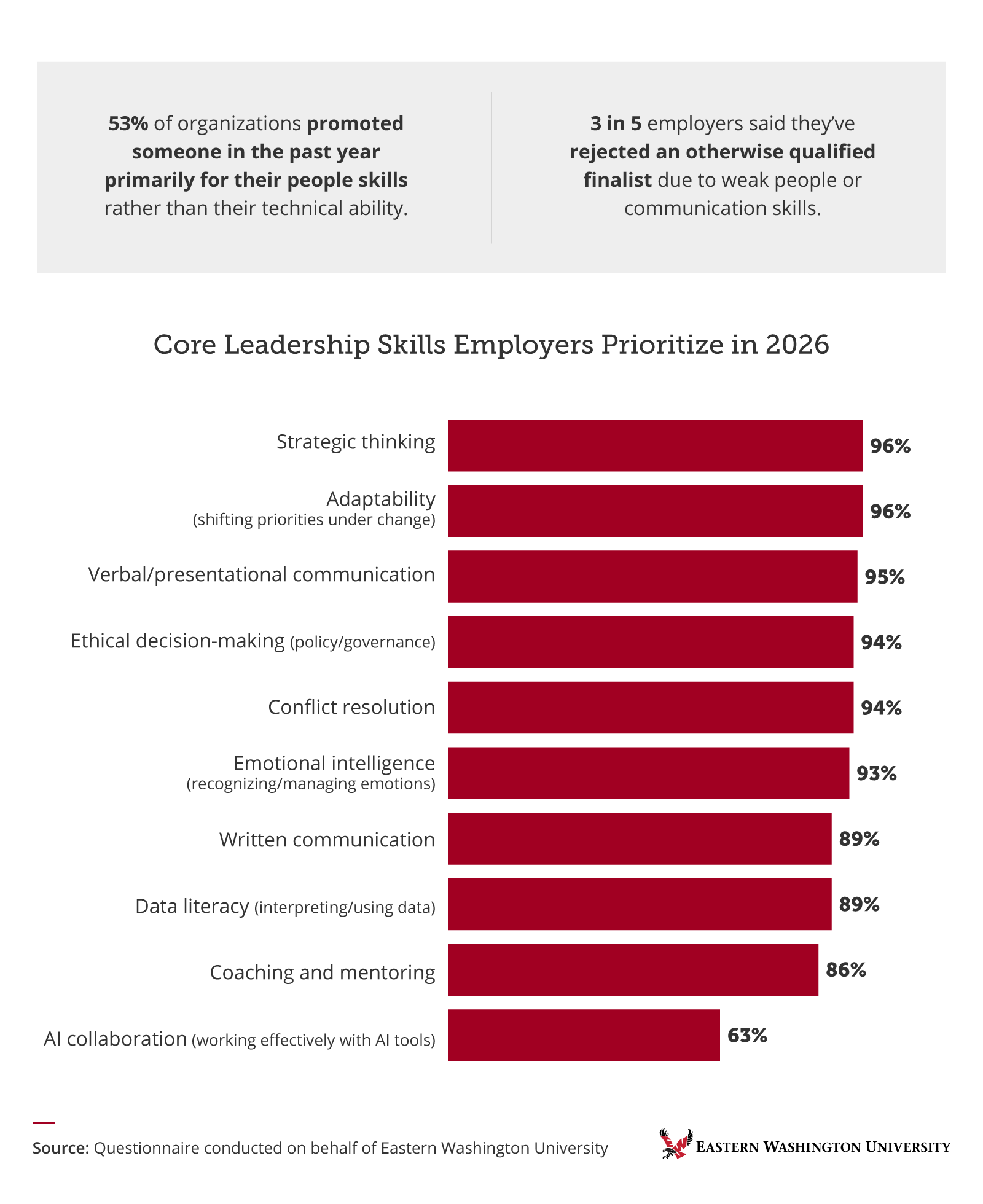
- 53% of organizations promoted someone in the past year primarily for their people skills rather than their technical ability.
- Three in five employers said they’ve rejected an otherwise qualified finalist due to weak people or communication skills.
- Across all evaluated competencies, MBA graduates scored roughly 10% higher in overall preparedness than bachelor’s graduates, according to hiring managers.
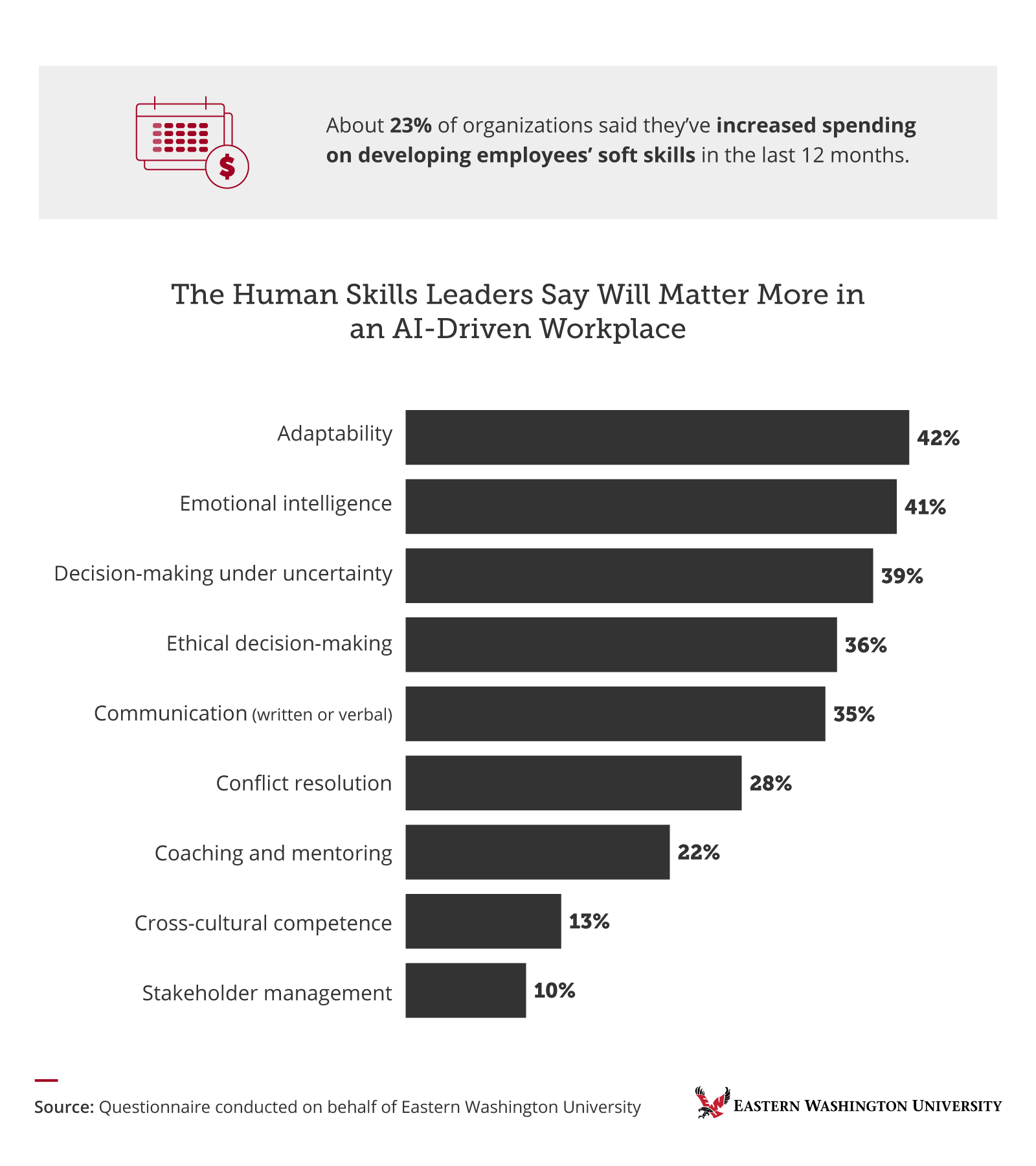
- About 23% of organizations said they’ve increased spending on developing employees’ soft skills in the last 12 months.
Why People Skills Are Driving Leadership Decisions
How Hiring Managers Rate the Preparedness of Bachelor’s Degree vs. MBA Degree Graduates
| Leadership Skill | Bachelor’s Degree Graduates Prepared (%) | MBA Degree Graduates Prepared (%) | MBA Advantage (pts) |
| Data literacy
(interpreting/using data) |
88% | 89% | +1 |
| AI collaboration
(working with AI tools) |
82% | 84% | +2 |
| Written communication | 81% | 88% | +7 |
| Verbal or presentational communication | 79% | 88% | +9 |
| Ethical decision-making | 79% | 86% | +7 |
| Strategic thinking | 78% | 89% | +11 |
| Adaptability under change | 76% | 86% | +10 |
| Emotional intelligence | 68% | 82% | +14 |
| Conflict resolution | 62% | 81% | +19 |
| Coaching and mentoring | 59% | 81% | +22 |
- Across all evaluated competencies, MBA graduates scored roughly 10% higher in overall preparedness than bachelor’s graduates, according to hiring managers.
What Most Often Tips the Decision Between Leadership-track Finalists:
- Strategic problem-solving: 48%
- Communication (written or verbal): 48%
- Adaptability under change: 37%
- Technical expertise or deep domain knowledge: 37%
- Years of experience: 30%
- Emotional intelligence: 29%
- Demonstrated team coaching or mentoring: 22%
- Ethical judgment: 18%
- Educational pedigree (institution prestige): 10%
Where Employers Most Often Train Entry-level Hires:
- Time management and prioritization: 41%
- Client or customer communication: 38%
- Conflict resolution: 27%
- Writing clarity and structure: 24%
- Giving and receiving feedback: 23%
- Spreadsheet or data analysis: 18%
- Ethical reasoning: 16%
- AI tool use or prompting basics: 16%
- Public speaking or presenting: 15%
The Growing Investment in Human-centered Leadership
- Nearly four in five hiring managers (79%) agree that strong people skills matter more than small differences in technical ability for leadership-track roles.
- 79% of employers say human-centered leadership skills will become even more important as AI and automation continue to expand.
- 75% of hiring managers admit that soft skills are harder to evaluate reliably than technical skills during the hiring process.
- Two-thirds of organizations (66%) said they assess human-centered skills more rigorously today than they did just two years ago.
- 60% of hiring managers believe an accredited online MBA can develop leadership skills just as effectively as an in-person program.
- Just over half of employers (53%) feel traditional degree programs place enough emphasis on ethical decision-making.
The Most Effective Pathways for Developing Human-centered Leadership Skills, According to Hiring Managers:
- Internal mentoring and coaching: 89%
- On-the-job stretch assignments: 85%
- Employer-run leadership programs: 83%
- In-person MBA programs: 83%
- Rotations and externships: 81%
- Industry association workshops: 77%
- Graduate certificates in organizational leadership: 74%
- Online MBA programs: 68%
- Self-directed learning (books, podcasts): 66%
- Short online courses or certificates: 63%
How Hiring Managers Assess Human-centered Leadership Skills:
- Structured behavioral interviews: 37%
- Work samples, simulations or role plays: 35%
- Situational judgment tests: 33%
- Standardized interview rubrics: 30%
- Case interviews: 25%
- Personality or psychometric assessments: 24%
- Assessment centers: 16%
- AI-assisted screening tools: 15%
- Do not formally assess these skills: 13%
What the Shift Toward Soft Skills Means for Future Leaders
Taken together, the findings suggest that future leaders need to be intentional about how they build people skills alongside technical expertise. For professionals considering an MBA, this means looking beyond course titles and rankings to evaluate whether a program actively develops adaptability, communication, ethical decision-making and emotional intelligence in applied ways.
These competencies were consistently tied to promotion decisions, leadership readiness and career growth. As organizations continue to prioritize leaders who can guide teams through complexity and change, choosing an MBA with a clear emphasis on soft skills can help professionals position themselves for advancement rather than simply credential attainment.
Methodology
This report is based on a national questionnaire of 500 hiring managers and business leaders across the U.S., conducted on December 16, 2025. The questionnaire aimed to examine how the definition of strong leadership is evolving and to identify where traditional business education may be falling short of current employer expectations.
Respondents were asked about the skills they prioritize when promoting or hiring leaders, the role of human-centered competencies in leadership-track decisions and how emerging technologies, such as automation and AI, are reshaping what effective leadership looks like in practice. The survey also explored perceptions of recent graduates and MBA holders, highlighting gaps between formal education and the real-world leadership capabilities organizations say they need most.
While the findings offer timely and directional insight into employer expectations and the future of leadership development, the results are based on self-reported data and a limited sample size. As such, they should be interpreted as indicative rather than definitive. The insights serve as a foundation for understanding shifting leadership demands and inform ongoing conversations around workforce development, business education and leadership training in an increasingly automated world.
About Eastern Washington University
Eastern Washington University offers flexible online programs designed for working professionals seeking to advance their leadership skills. EWU’s online business degree programs emphasize ethical decision-making, effective communication and strategic thinking to help students meet the expectations of modern employers. Learn more about the online MBA with an Organizational Leadership Concentration program today.
Fair Use Statement
The information in this article may be used for noncommercial purposes only. If shared or cited, proper attribution and a link back to Eastern Washington University must be included.