Artificial intelligence is becoming a regular part of work in many industries, changing how tasks are completed and what skills employers expect. For higher education degree earners, these changes can affect confidence, career planning and decisions about what to learn next. To better understand these experiences, a questionnaire conducted on behalf of Eastern Washington University (EWU) surveyed 500 higher education degree earners across the U.S.
This research aimed to better understand how AI is affecting career readiness and skill choices. The findings showed that many higher education degree earners were interested in using AI at work but also concerned about how automation could affect their roles. Responses also pointed to responsible AI use and data literacy as practical areas of focus for staying competitive in today’s workforce.
Key Takeaways
- Nearly half of higher education degree earners (48%) see AI as a career opportunity.
- About half (51%) are concerned that AI could automate entry-level tasks in their intended field before they enter the workforce.
- More than one in three (35%) say AI has made them feel less confident about pursuing entry-level jobs after graduation.
- Nearly two-thirds (65%) say they are interested in learning data analytics.
How Higher Education Degree Earners Are Using AI and Building Skills
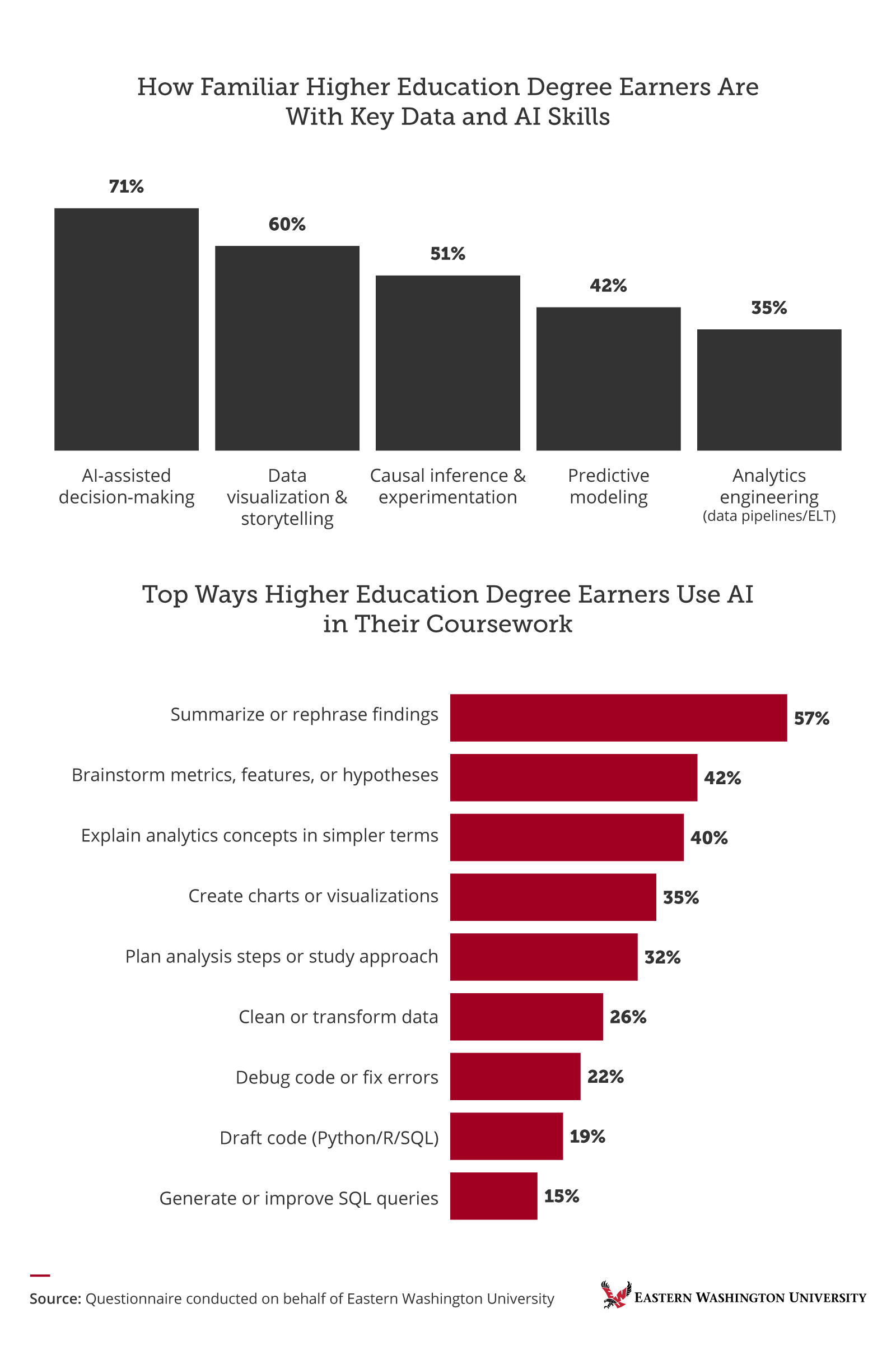
Artificial intelligence is increasingly influencing how learners approach coursework and skill development. As AI tools become more common in academic settings, many are integrating them into learning, analysis and problem-solving tasks.
Programs higher education degree earners are currently pursuing:
- Bachelor’s degree: 47%
- Master’s degree (non-MBA): 20%
- Associate degree (two-year): 15%
- Doctoral degree: 9%
- Certificate or for-credit micro-credential: 5%
- MBA: 4%
How higher education degree earners describe AI policies at their institution:
- Policies vary by instructor or course: 41%
- Clear: AI allowed with guidelines: 26%
- Clear: AI restricted or prohibited: 20%
- Unclear or inconsistent policies: 9%
- Not sure: 4%
Employer expectations and workplace readiness:
- 81% of higher education degree earners say employers will expect interns and new hires to use AI responsibly.
- 71% say data literacy will be a must-have skill for career success.
- 68% believe AI will automate parts of entry-level work.
- 67% feel confident collaborating effectively with AI tools.
- 38% are excited about the new types of jobs AI may create.
Views on Career Impact and Skill Priorities
Higher education degree earners are considering how AI may affect their career paths. Some view data-focused capabilities as a practical way to engage with AI rather than compete against it.
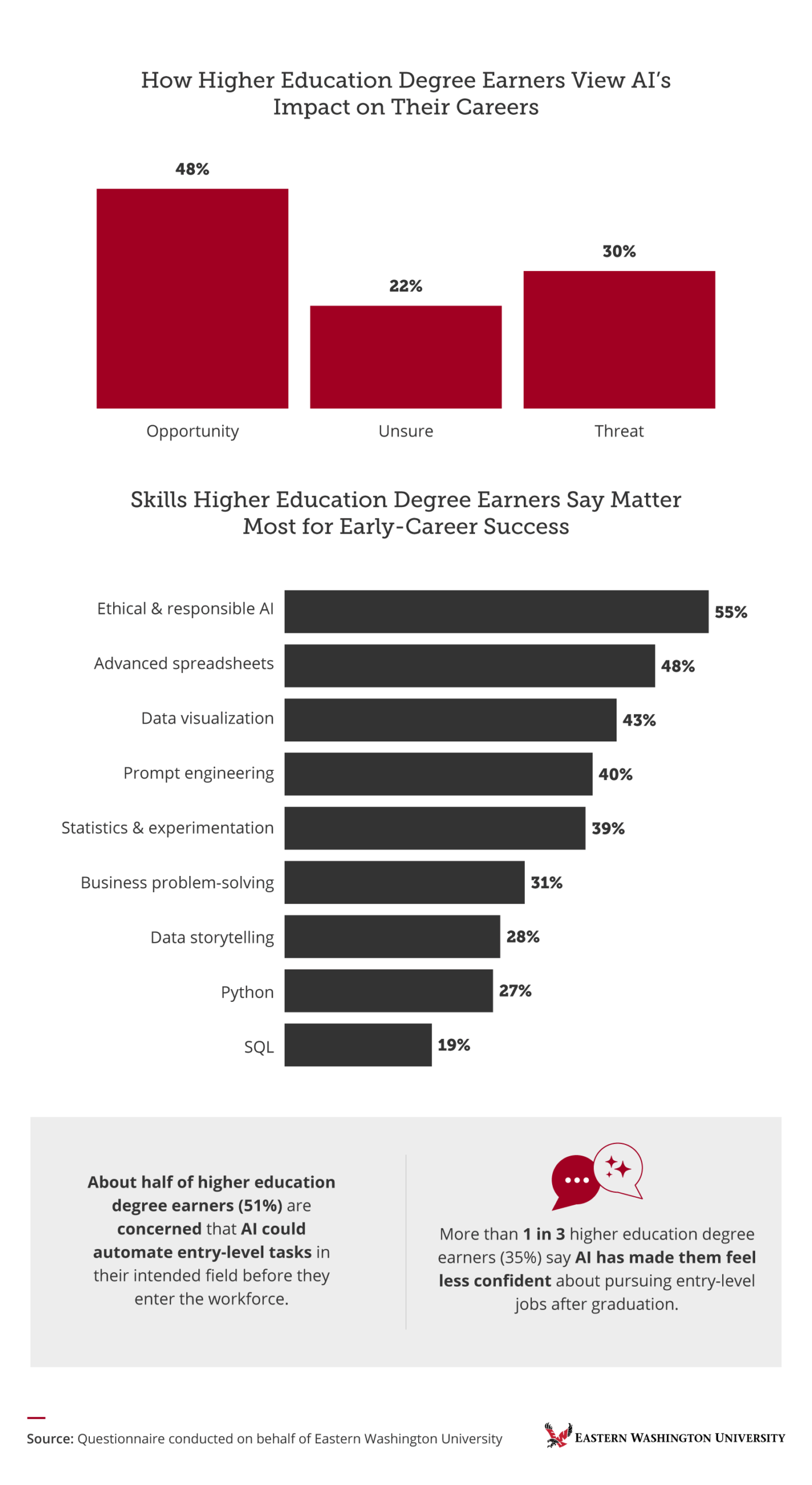
- Almost two-thirds (65%) are interested in learning data analytics, with 38% reporting that AI has increased this interest.
Fields where higher education degree earners are most likely to see AI as a career opportunity:
- Computer or data science: 62%
- Education: 61%
- Engineering: 57%
Fields where higher education degree earners are most likely to view AI as a career threat:
- Communications
- Arts or humanities
- Business, management or economics
Methodology
A questionnaire of 500 higher education degree earners in the U.S. was conducted on behalf of EWU to understand how AI is shaping perceptions of career readiness, skill development and the value of additional education. The questionnaire explores how degree earners view AI as a career threat or opportunity, which skills they believe are most essential for early-career success, how AI is influencing their learning behaviors and how confident they feel entering the workforce in an increasingly automated economy.
The average age of respondents was 32; 58% were female, 37% were male and 4% were non-binary. Generationally, 14% were Gen X and older generations, 39% were millennials, and 47% were Gen Z. Percentages in this study may not total 100% exactly due to rounding.
This is a non-scientific, exploratory questionnaire designed to explore behavioral and attitudinal trends. It is not intended to represent all higher education degree earners.
About Eastern Washington University
Eastern Washington University offers online programs designed for working adults who want flexibility while continuing to build career momentum. For learners interested in strengthening data-informed leadership skills, the online Master of Business Administration (MBA) with a Data Analytics Concentration program can help develop competencies in analysis, strategy and decision-making.
Fair Use Statement
The information in this article may be used for noncommercial purposes only. If you share or reference these findings, please include proper attribution and a link to Eastern Washington University.