
Cybersecurity threats are becoming increasingly frequent and more complex, to the point where many companies are now looking for leaders who can manage both risk and response. As demand grows, organizations are turning to professionals with the expertise to bridge cybersecurity fundamentals and business leadership.
Two graduate-level paths stand out for aspiring cybersecurity professionals: the Master of Business Administration (MBA) in cybersecurity and the Master of Science (MS) in cybersecurity. While the MS offers in-depth technical training, the MBA is tailored for those who want to lead teams, manage strategies and influence company-wide decision-making. This article compares both options in terms of admissions, coursework and career outcomes, so you can choose the best path for your goals.
One standout program is the online Master of Business Administration with a Cybersecurity Concentration from Eastern Washington University (EWU). It’s designed for working professionals who want flexibility and a direct path to leadership.
What Is an MBA in Cybersecurity?
A Master of Business Administration with a focus on cybersecurity prepares professionals to lead in business environments where digital threats are a top priority. This degree combines core business management and strategic management courses, such as finance, operations and organizational leadership, with cybersecurity management training in areas like enterprise security, cyber risk and data governance.
Rather than diving deep into technical tools, a cybersecurity MBA emphasizes how to use business intelligence and strategy to manage teams and align security initiatives with organizational goals. Students learn how to approach cybersecurity not just as a technical issue, but as a business-critical function.
The 2025 ISC2 Cybersecurity Workforce Study highlights a clear trend in what employers look for. Beyond technical ability, they want cybersecurity professionals who can think strategically and handle messy, high-stakes problems. The report also calls out rising demand for non-technical skills like communication, teamwork and attention to detail. That’s the role an MBA graduate is trained to fill, making them strong candidates for leadership positions like CISO, VP of Information Security or Director of Risk Management.
What Is an MS in Cybersecurity?
An MS in cybersecurity is a technically focused master’s degree that prepares students to design, implement and maintain security systems. This degree path goes in-depth on topics like vulnerability assessment, cyber threats, network security and information systems architecture.
Students gain hands-on experience with digital forensics, cyber defense, encryption, malware analysis and systems protection. Most programs also train students to work with advanced tools and frameworks used in information technology and information security roles.
This program is ideal for those who want to build or deepen their technical expertise and work in roles such as security analyst, penetration tester, cybersecurity engineer or incident response specialist. Graduates are well-equipped to assess threats, secure infrastructures and apply real-time defense strategies in sectors ranging from healthcare to finance.
MBA vs. MS in Cybersecurity: Key Differences
Understanding the differences between an MBA in Cybersecurity and an MS in cybersecurity helps you decide which path best supports your professional goals, learning style and career trajectory. One degree leans more toward business strategy and leadership, while the other focuses on technical mastery and hands‑on defense skills.
Prerequisites and Admission Requirements
MBA programs like Eastern Washington University’s online cybersecurity MBA typically require a bachelor’s degree from an accredited institution, official transcripts and a professional resume as part of the admission process. A cumulative GPA of 3.0 is standard, though exceptions are possible with professional experience or index scores combining GPA and GMAT results. The GMAT may be waived for qualified applicants in some cases.
MS in cybersecurity programs also require a bachelor’s degree, but many favor technical backgrounds such as computer science, information technology or engineering. Applicants may need to show foundational knowledge in programming, networking or systems, especially when applying to more technical graduate cybersecurity programs.
Coursework and Curriculum
MBA coursework emphasizes business principles alongside cybersecurity management. Core courses cover business decision-making, strategic planning, leadership, analytics and risk management, with cybersecurity electives to build domain knowledge. MS in cybersecurity programs focus primarily on technical topics like network security, vulnerability assessment and digital forensics.
Career Outcomes and Earning Potential
Career outcomes reflect the focus of each degree. Graduates with an MBA in Cybersecurity often move into leadership and business management roles overseeing teams, strategy and organizational security policy. They may become information security managers, cybersecurity program directors or executives who balance business leaders with technical teams. MS graduates typically pursue specialist or technical roles such as information security analyst, penetration tester or cybersecurity engineer.
According to the U.S. Bureau of Labor Statistics (BLS), the median annual wage for information security analysts was about $124,910 in 2024, and employment in this field is projected to grow significantly faster than average for all occupations, underscoring strong demand for technical cybersecurity expertise.
Both paths can lead to high compensation, but pay can swing widely based on role, industry, specialization and experience. Leadership roles often come with higher salaries, especially when paired with business acumen and strategic management skills.
Who Should Choose an MBA in Cybersecurity?
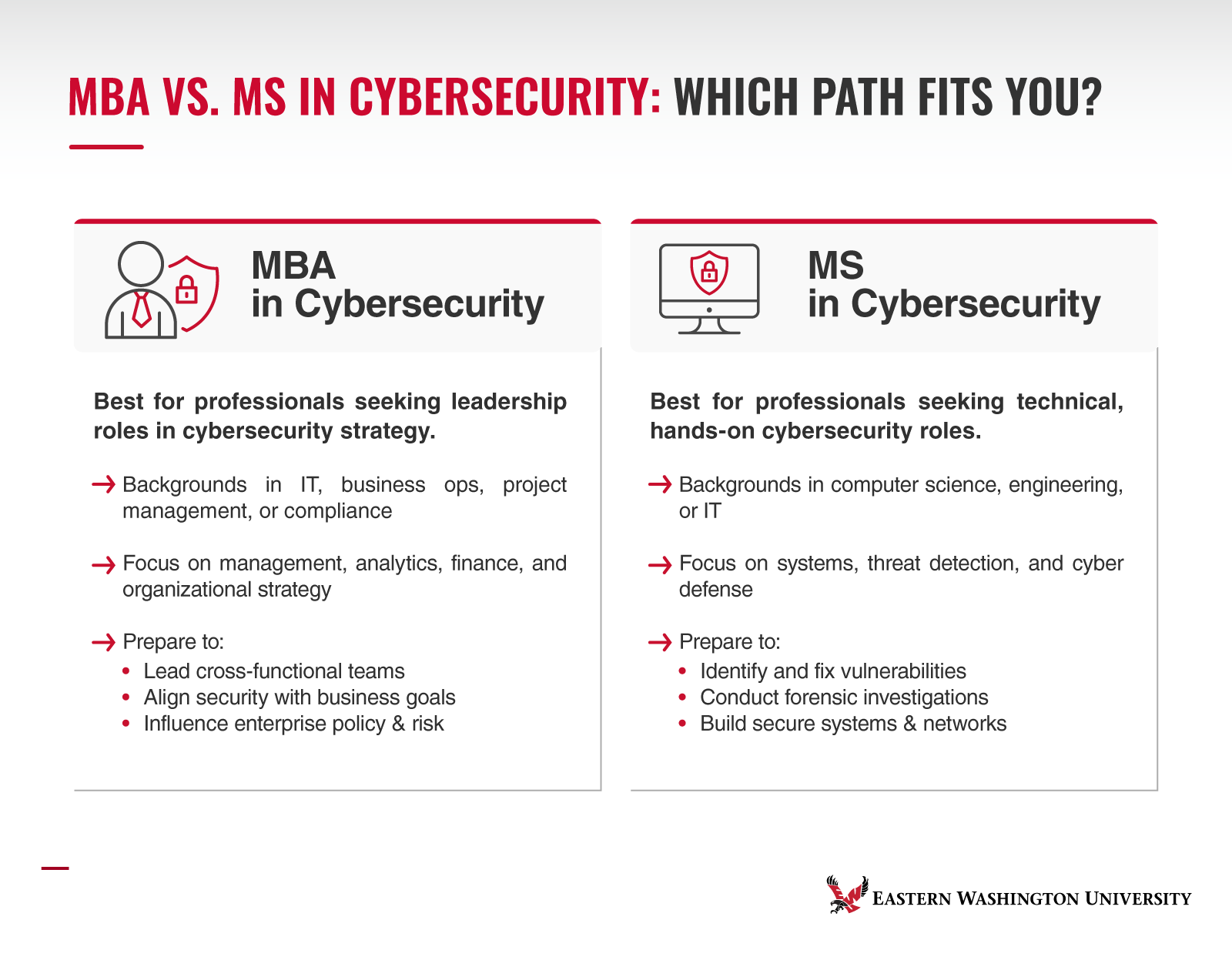
An MBA in Cybersecurity is ideal for professionals who want to transition into management roles or lead cybersecurity strategy across an organization. This path suits candidates with backgrounds in IT, project management, business operations or compliance, especially those looking to expand their impact beyond a single department or technical role.
Pursuing a cybersecurity management degree provides value for professionals who want to grow strategically and cross-functionally. By building expertise in finance, communication, analytics and strategic management, students learn how to make informed, high-level decisions in complex digital environments.
Graduates emerge as capable business leaders ready to drive security initiatives, oversee multidisciplinary teams and align business objectives with secure practices. This degree is especially suited to those who want to influence policies, manage enterprise risk and connect cybersecurity strategy to broader organizational goals.
Who Should Choose an MS in Cybersecurity?
A Master of Science in Cybersecurity is the best fit for students who want to deepen their technical expertise and pursue hands-on roles in cyber defense. This degree appeals to those with backgrounds in computer science, engineering or IT, who have a strong interest in addressing cybersecurity risk, defending against cyber threats and identifying system vulnerabilities.
Graduates of an MS program are often prepared for specialized roles like cybersecurity analyst, penetration tester, digital forensic investigator or systems engineer. The curriculum typically focuses on information systems, network security and threat detection, then reinforces those skills through lab work and simulation exercises that reflect real-world scenarios.
If you want a technically intensive cybersecurity program that builds deep, hands-on knowledge for preventing and responding to cyberattacks, this degree is a strong fit. It provides the foundation and career pathway for operational cybersecurity roles.
Why Choose Eastern Washington University’s Online MBA – Cybersecurity Concentration?
Eastern Washington University’s online MBA degree with a cybersecurity concentration offers a unique blend of strategic business education and cybersecurity training. Designed for working professionals, the program combines leadership development, risk management and cybersecurity insights to help students manage security from a high-level, strategic perspective.
A fully online master’s format makes it easier to keep working while you build new skills, especially if your schedule is not predictable. It also reflects what many employers need now: leaders who understand business operations and the digital security challenges that come with them. If you are aiming for a promotion or planning a shift into a new role, the program is designed to help you lead in a cyber-driven business environment with clearer decision-making and communication skills.
Program Structure
The online MBA is structured for flexibility, offering multiple start dates throughout the year and accelerated pacing for students who want to finish quickly. Eastern Washington University’s program consists of 44 credit hours, making it an accessible option for working professionals.
The program is fully online, so students can study from anywhere while earning a degree from a regionally accredited university. It is built to work with varied schedules and can be completed in as few as 10 months.
Core Curriculum and Training
The core curriculum covers essential cybersecurity management topics while reinforcing competencies in leadership, analytics and strategic management. Students explore cyber risk, business ethics, organizational behavior and data-informed decision-making.
Applied learning shows up through case-based assignments and real-world case studies that ask students to work through business problems from both operational and security perspectives. By building technical understanding alongside business insight, graduates are prepared to lead security efforts in a wide range of industries.
Career Readiness and Outcomes
Graduates of the program are prepared for a wide range of cybersecurity career paths, particularly those requiring leadership and cross-functional coordination. Roles include security program manager, CISO, director of information security or business consultant focused on security and risk.
By combining business fluency with technical awareness, the program supports advancement into managerial roles and high-impact positions that require long-term strategic planning. EWU’s MBA program is designed for professionals moving into leadership for the first time or expanding into a broader executive role. It helps students build the kind of business judgment that supports both protecting the organization and driving sustainable growth.
Move Forward in Your Cybersecurity Career

If you are just getting started in cybersecurity or aiming for a more strategic role, the right education can shape your next steps. Focus on a graduate degree that matches your goals, because the field moves fast and the best path is the one that builds skills you will actually use.
Eastern Washington University’s online programs are designed for working professionals who want to build expertise and advance without putting their careers on hold. The cybersecurity MBA blends technical understanding with leadership preparation and is ideal for those ready to influence decision-making at the highest levels. To learn more about this flexible, career-focused program, request information or explore EWU’s online degree program today.
Frequently Asked Questions
Choosing the right graduate degree in cybersecurity depends on your career goals, current skill set and future aspirations. Below are common questions prospective students ask when weighing the value of an MBA in Cybersecurity and considering Eastern Washington University’s program.
Is an MBA good for cybersecurity?
Yes, an MBA in Cybersecurity is especially valuable for professionals looking to move into leadership roles within cybersecurity teams or organizations. Unlike technical programs, an MBA develops broad business leadership and cybersecurity management skills, enabling graduates to oversee strategy, communicate with executives and make business-aligned security decisions. It’s best suited for professionals who want to lead teams or influence high-level policy rather than work in purely technical roles.
What are the benefits of pursuing an MBA in Cybersecurity?
An MBA in Cybersecurity enhances your ability to lead, make informed decisions and understand both the technical and business sides of risk. With training in decision-making, cybersecurity management and strategic planning, the degree supports advancement into interdisciplinary roles where managing people, policies and security priorities intersect. It’s a powerful tool for moving up the leadership ladder in today’s digital-first organizations.
What are some trends in cybersecurity?
AI is playing a growing role in both cyber threats and cyber defense. Professionals now need to understand AI security, automation, cloud infrastructure and threat intelligence to stay competitive. As cybersecurity risk becomes more complex, there’s increasing demand for leaders who can manage these challenges with both technical insight and strategic thinking, which are skills emphasized in modern cybersecurity management programs.
Does EWU offer scholarships for this online MBA in Cybersecurity?
Yes. Eastern Washington University offers multiple forms of financial aid, including federal aid, loans and possible tuition support for eligible students. To explore available options and see what you may qualify for, prospective students are encouraged to request info or visit the program page directly.
How long does it take to complete this online MBA in Cybersecurity?
EWU’s online MBA with a cybersecurity concentration can be finished in as few as 10 months full-time. Part-time students may take longer, depending on course load and personal schedules. The program requires approximately 44 credit hours, and multiple start dates are available throughout the year, making it a flexible option for professionals looking for an accelerated degree program.