Online MBA programs are growing rapidly as working professionals, often with a bachelor’s degree, seek ways to earn a graduate degree without stepping away from their careers. To better understand this shift from traditional on-campus programs to online learning, a questionnaire was conducted on behalf of Eastern Washington University (EWU). It surveyed 489 online MBA students and recent graduates who had enrolled in an online MBA program within the past three years.
This research aimed to explore the factors influencing prospective MBA students and business professionals in their evaluation of graduate programs. The findings reveal where online MBA programs are gaining momentum across the U.S. and why professionals are choosing digital degree programs. The data also highlights the motivations driving enrollment, from career advancement and salary growth to concerns about automation and economic uncertainty.
Key Takeaways
- New Hampshire ranks No. 1 state in online MBA growth, followed by Kansas and Massachusetts.
- Flexibility (44%) beat out cost (32%) as the top reason learners chose an online MBA.
- For 73% of online MBA students, avoiding debt was extremely or very important in their decision to pursue an MBA online.
- Half of online MBA students said concerns about AI or automation impacted their decision to enroll.
- 68% of online MBA students said they would feel more economically secure having an MBA if the economy declines in 2026.
The State-by-State Online MBA Leaderboard
Online MBA programs are expanding across the country, but growth is not evenly distributed. Some states are seeing rapid adoption of virtual graduate programs, while others show relatively little activity. Examining enrollment trends and program availability reveals how demand for flexible business education varies by region.
The Online MBA Boom Index ranks all 50 states using three indicators that capture both student demand and program supply. These include graduate business degree completions, online MBA-related search interest and the number of AACSB-accredited schools offering online MBA programs. Each metric was adjusted for population and combined into a final score to identify where online MBA degree programs are gaining the most traction.
New Hampshire ranked first overall in the index, followed by Kansas and Massachusetts. Several of the states leading the rankings are among the least populous in the country, including Alaska, North Dakota and Delaware. Despite their smaller populations, they outperformed larger states such as California, Texas and Florida in demand indicators tied to online MBA programs.
Top 15 States: Where Online MBAs Are Booming
- New Hampshire
- Kansas
- Massachusetts
- Utah
- Connecticut
- Louisiana
- Delaware
- Rhode Island
- North Dakota
- Alabama
- New York
- West Virginia
- Alaska
- Indiana
- Illinois
Some states showed lower levels of online MBA activity across enrollment and search demand indicators. The bottom 15 included:
- Montana
- Wyoming
- Oregon
- Nevada
- Iowa
- New Mexico
- Florida
- Maine
- Mississippi
- Hawaii
- California
- Idaho
- Minnesota
- Michigan
- Arizona
A lower index placement does not necessarily indicate a lack of graduate business education options. Instead, it suggests that interest in online MBA programs relative to population size is lower than in other parts of the country.
Graduate Business Degrees Awarded
States with large populations naturally produce more graduate business degrees. These figures reflect total master’s degree completions in business programs.
Top five states by graduate business degrees awarded:
- California: 17,031
- New York: 14,103
- Texas: 12,907
- Massachusetts: 12,298
- Illinois: 11,954
Bottom five states by graduate business degrees awarded:
- Hawaii: 271
- Vermont: 226
- Montana: 140
- Wyoming: 133
- Alaska: 90
Large states often dominate raw totals due to higher enrollment across multiple colleges of business and graduate programs.
AACSB-Accredited Online MBA Programs
Accreditation plays an important role in helping prospective MBA students evaluate program quality. Many business schools pursue accreditation from the Association to Advance Collegiate Schools of Business (AACSB), one of the most widely recognized standards for business education.
Top five states by number of AACSB-accredited online MBA programs:
- Texas: 38
- New York: 29
- California: 20 (tied)
- Pennsylvania: 20 (tied)
- Ohio: 17
The five states with the fewest AACSB-accredited online MBA programs:
- Maine: 1 (tied)
- Hawaii: 1 (tied)
- New Hampshire: 1 (tied)
- Montana: 0 (tied)
- Vermont: 0 (tied)
The contrast between supply and demand is notable. New Hampshire has just one AACSB-accredited online MBA program, yet it ranks first in the index, while Texas offers 38 accredited programs but ranks 32nd overall.
Flexibility Wins: What’s Driving the Online MBA Surge
Working professionals increasingly seek graduate programs that can fit around their existing responsibilities. Flexible online courses allow students to continue building work experience while completing MBA coursework at their own pace. Asynchronous learning and multiple start dates make it easier for learners to pursue career advancement without relocating or leaving full-time employment.
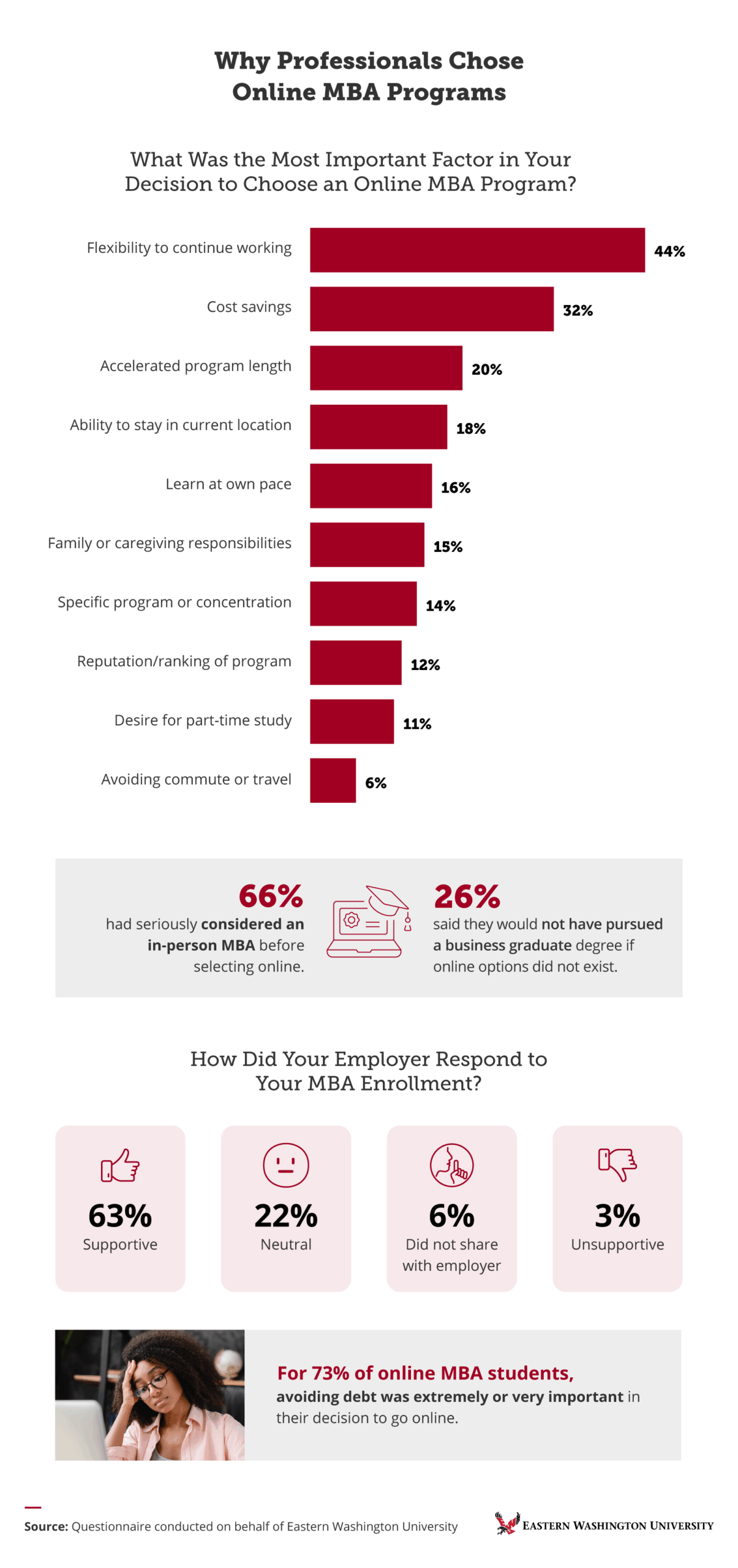
Flexibility emerged as the most influential factor among survey respondents. A total of 44% said flexibility motivated their decision to enroll in an online MBA program, exceeding cost considerations at 32%.
The importance of flexibility was especially pronounced among mid-career professionals. More than half of Gen X respondents (55%) said the ability to continue working influenced their decision to choose an online MBA program, compared with 42% of both Gen Z and millennials.
Most online MBA students were employed when they began their graduate degree program. Among respondents, 69% were working full-time, and another 25% were working part-time while completing their MBA courses. Smaller shares reported being self-employed entrepreneurs (3%) or not employed (3%) during enrollment.
Career advancement remained a primary goal for many MBA students. Sixty-three percent said they pursued an MBA to increase their salary in their current role or industry. Another 52% hoped the graduate degree would help them qualify for a promotion. Other top factors included:
- Desire to switch careers: 34%
- Concern about job instability or recent layoffs: 32%
- Concern about automation or artificial intelligence: 22%
- Participation in an employer-sponsored upskilling initiative: 15%
Financial considerations were also top of mind for many learners. Avoiding debt was extremely or very important for 73% of online MBA students when selecting their degree program.
The AI Effect
Rapid advances in artificial intelligence are quickly changing the modern business environment. As companies adopt new technologies, many professionals are seeking advanced business education to strengthen their skill set.
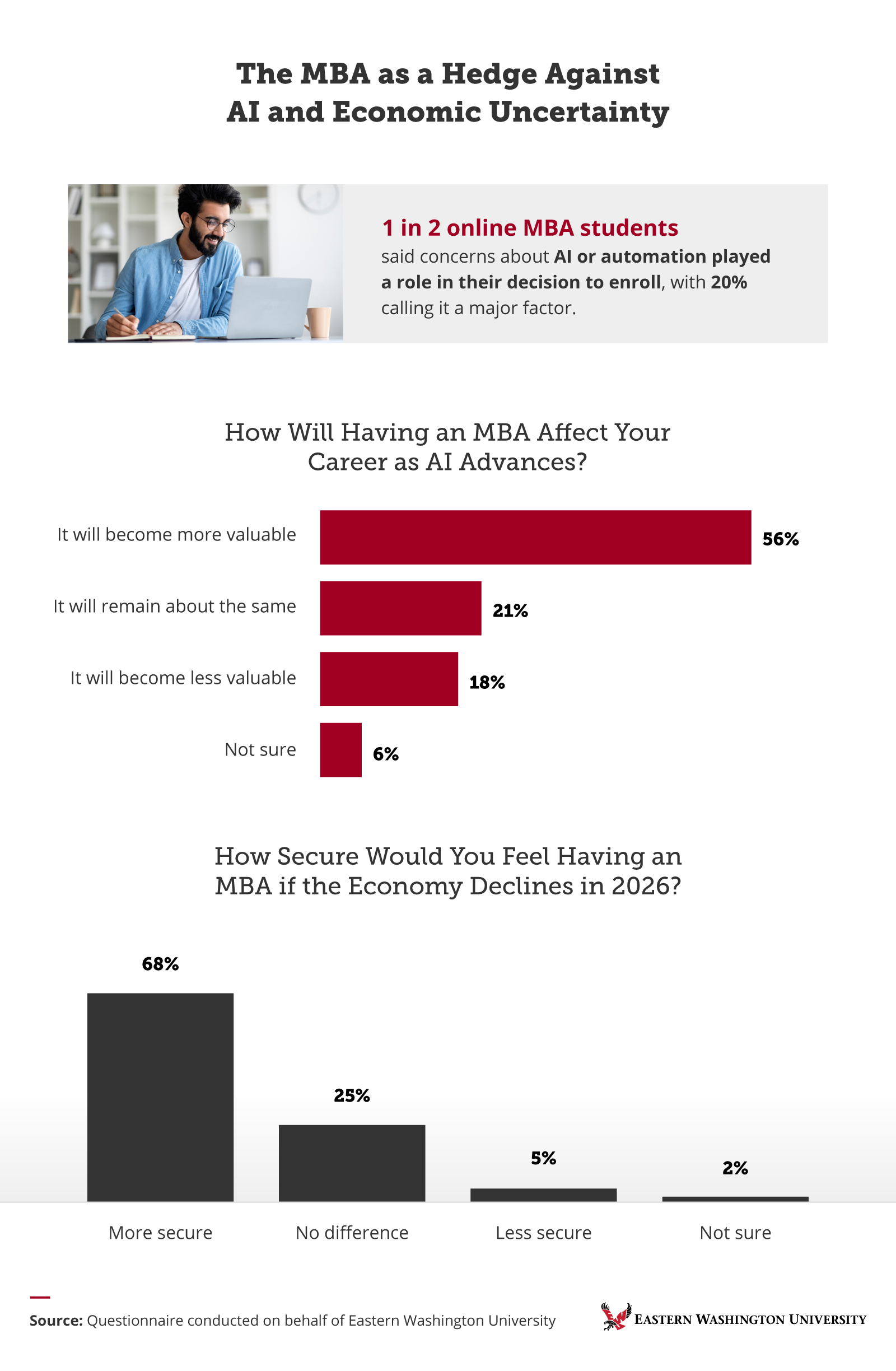
Half of online MBA students reported that concerns about AI or automation influenced their decision to pursue a graduate degree. Gen X (61%) was more likely to say so than Gen Z (58%) or millennials (42%). Senior leaders were the most convinced that they need the credential as a hedge against tech advancements. Among respondents, 80% of executives or C-level leaders said AI concerns influenced their decision to pursue an MBA. That share fell to 61% among senior managers, 48% among mid-level managers and 40% among associate-level employees.
Economic uncertainty was another motivating factor. Many online MBA students (68%) said they would feel more financially secure with an MBA if the economy declines in 2026. Senior managers expressed the highest level of concern about economic conditions. Among that group, 78% said they would feel more secure having an MBA if the economy weakens.
Entry-level professionals were the most focused on career mobility, with 38% reporting a desire to switch careers as a primary reason for enrolling in an online MBA program. Geographic flexibility also affected program decisions. Nearly half of respondents (48%) said they would not relocate to another state to obtain in-state tuition at a top-ranked online MBA program, while 31% said they would consider moving, and 21% were unsure.
Students also reported several concerns when evaluating online MBA programs, including:
- Return on investment: 29%
- Total cost: 22%
- Long-term value: 17%
- Time required: 13%
- Limited in-person networking: 11%
Belief in the long-term value of an MBA also varied by generation. Sixty-five percent of Gen X respondents said they believe an MBA will become more valuable as AI advances, compared with 59% of Gen Z and 50% of millennials.
What Does the Online MBA Boom Mean for Prospective Learners?
The growth of online MBA programs shows that flexible graduate education is becoming a practical pathway for working professionals who want to advance their careers. Many online MBA students balance full-time or part-time work while completing coursework, allowing them to build real-world experience while developing leadership, business analytics and strategic decision-making skills. For prospective students evaluating an online Master of Business Administration, factors such as program flexibility, cost considerations and long-term career goals often play a central role in choosing the right degree program.
As demand continues to rise, prospective MBA students researching the best online MBA programs should focus on finding an accredited institution that aligns with their professional goals and learning preferences. Evaluating factors such as admission requirements (including GRE/GMAT scores), available concentrations, elective courses, and the overall online learning experience can help learners select a program that supports their desired career path while aligning with their current work schedule.
Methodology
This questionnaire surveyed 489 online MBA students and recent MBA graduates on behalf of Eastern Washington University to explore the motivations, concerns and attitudes driving the shift toward online MBA programs. Respondents were currently enrolled in or had completed an online MBA program within the past three years. The findings reflect a non-scientific, exploratory questionnaire and are not intended to be nationally representative of all online MBA students or graduate business school candidates.
The Online MBA Boom Index ranks all 50 U.S. states across three weighted indicators that capture both supply and demand for online MBA programs, including:
- Graduate business degree completions (50%): Sourced from IPEDS (2023-2024 Completions survey), this measures master’s-level degrees awarded under CIP code 52 (Business Management and Administrative Services). Completions are attributed to the school’s location, not the student’s home state.
- Online MBA search interest (30%): Aggregated search volume across online MBA-related keywords, capturing total demand from prospective students at the state level
- AACSB-accredited online MBA programs (20%): Count of AACSB-accredited schools offering fully online Master’s programs per state, sourced directly from the AACSB school directory (401 U.S. institutions at time of collection)
All three indicators were normalized per 100,000 residents using U.S. Census Bureau population estimates and scaled using min-max normalization before being combined into a final score out of 100. Data was collected in February 2026.
About Eastern Washington University
Eastern Washington University offers online MBA programs designed for working professionals who want to strengthen leadership, analytical and strategic decision-making skills. EWU’s MBA degrees are delivered through a flexible online format that allows learners to complete coursework while balancing career and personal responsibilities.
Through EWU’s School of Business, degree earners build practical competencies in areas such as data analytics, operations management, finance, healthcare administration and international business while developing the skills needed to solve real-world business problems. The university also supports prospective students through a guided MBA admissions and application process, as well as with resources to explore financial aid options.
Fair Use Statement
The information and findings presented in this article may be used for noncommercial purposes only. When sharing or referencing this content, please provide proper attribution and include a link back to Eastern Washington University.