
Artificial intelligence tools like ChatGPT, Claude and Copilot are becoming everyday companions at work, changing how employees brainstorm ideas, communicate and solve problems. As AI adoption accelerates across industries, it is also reshaping how professionals perceive their competence, confidence and value in the workplace. For many workers, this shift intersects with imposter syndrome, the feeling that one is not as capable as others believe.
The findings in this article come from a questionnaire administered to 1,000 full-time and part-time employees on behalf of Eastern Washington University (EWU). Respondents represented a range of generations and industries, including tech, healthcare, education, and retail and hospitality. This research aimed to better understand how AI use influences confidence, skill development and feelings of inadequacy at work, revealing both opportunities for growth and new challenges for today’s workforce.
Key Takeaways
- 25% of employees said AI has made them more confident in performing tasks at work, but 11% still rely on AI for functions they don’t fully understand.
- 16% of workers often use AI tools to catch up on things they didn’t fully understand during meetings, and Gen Z is the most likely to do so (23%).
- 50% of Gen Z said that using AI has made them more confident in their day-to-day work, and 57% said it has helped them develop new skills.
- Employees who use AI daily are most likely to report regularly experiencing imposter syndrome (30%).
AI as a Confidence Booster and a Crutch
AI tools are increasingly positioned as productivity aids that help employees move faster and work smarter. Their accessibility makes them appealing during moments of uncertainty, especially when workers feel pressure to perform. Understanding how confidence and reliance intersect helps clarify AI’s dual impact at work.
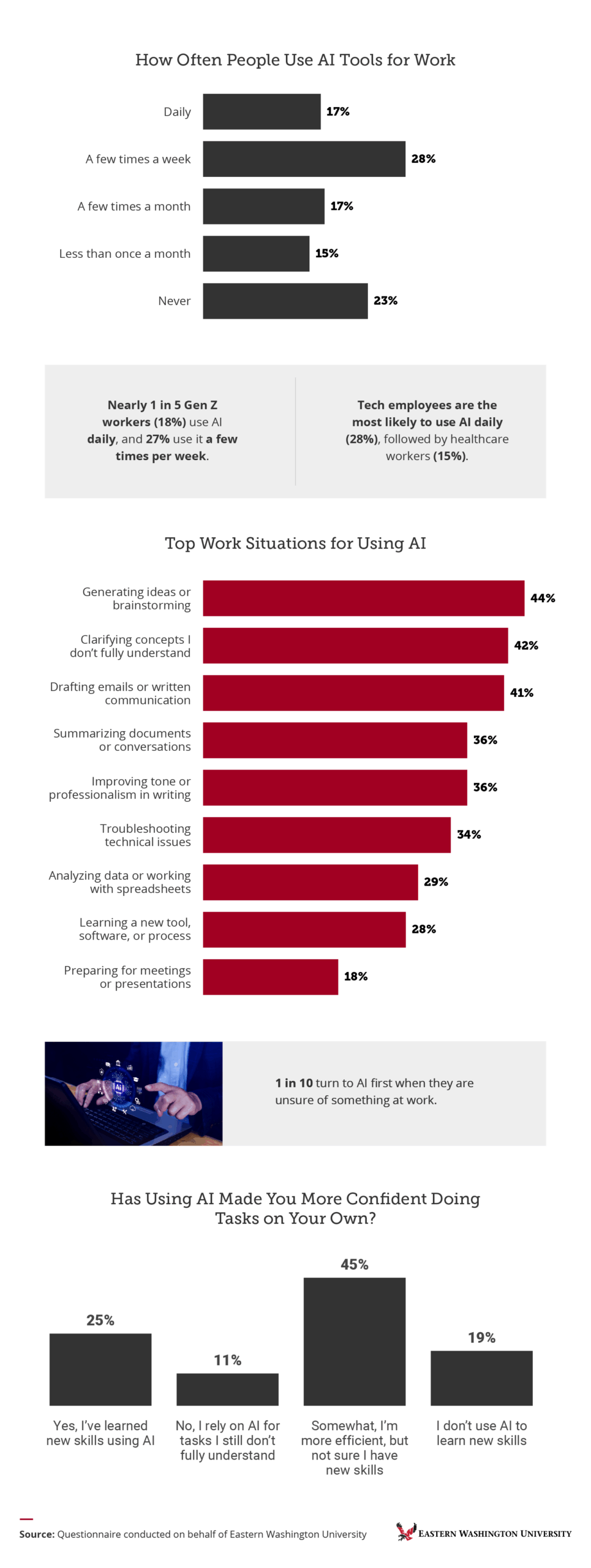
Workers most often used AI for brainstorming (44%), clarifying confusing concepts (42%) and drafting communications (41%). These uses highlight how AI often acts as a confidence buffer, stepping in when employees feel unsure about their ideas or knowledge.
Survey results showed that 25% of employees said AI has made them more confident in performing tasks independently at work. At the same time, 11% reported relying on AI for tasks they did not fully understand.
Reliance sometimes begins early in the problem-solving process. One in 10 employees said they turn to AI first when they are unsure of something at work, instead of asking a colleague.
When AI Reduces and Reinforces Imposter Syndrome
AI’s influence on imposter syndrome was not uniform across the workforce. While some employees felt empowered by access to AI, others experienced heightened anxiety and self-doubt. These contrasting outcomes underscore how usage patterns and workplace context shape employee experiences.
Among AI users, 20% said the tools help them feel more confident and prepared, while 9% reported increased anxiety or feelings of inadequacy. Half of Gen Z employees said using AI has made them more confident in their day-to-day work, and 57% said it has helped them develop new skills. Overall, 54% of respondents agreed that AI tools help build relevant skills, while 27% disagreed.
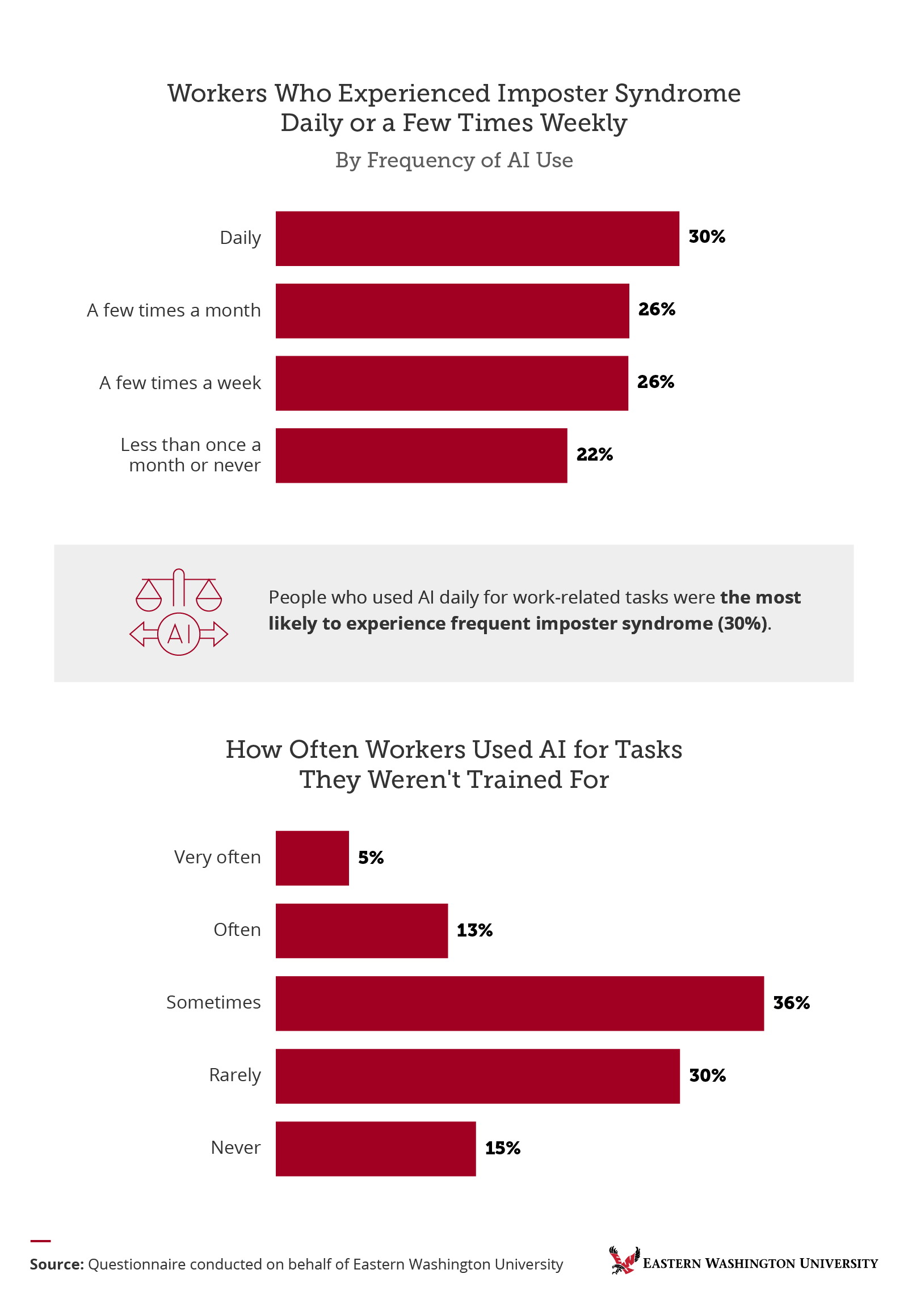
AI use also sometimes came with trade-offs that may reinforce imposter syndrome. Fifteen percent of employees said access to AI made them less likely to ask clarifying questions in meetings, potentially allowing misunderstandings to go unaddressed. Daily AI users were the most likely to report regularly experiencing imposter syndrome, at 30%. Frequent reliance on these tools may heighten self-doubt for some users.
Training Gaps and Learning on the Fly
As AI tools become embedded in daily workflows, formal training has not always kept pace. Many employees are left to figure out how and when to use AI on their own, which can intensify uncertainty and reliance on others.
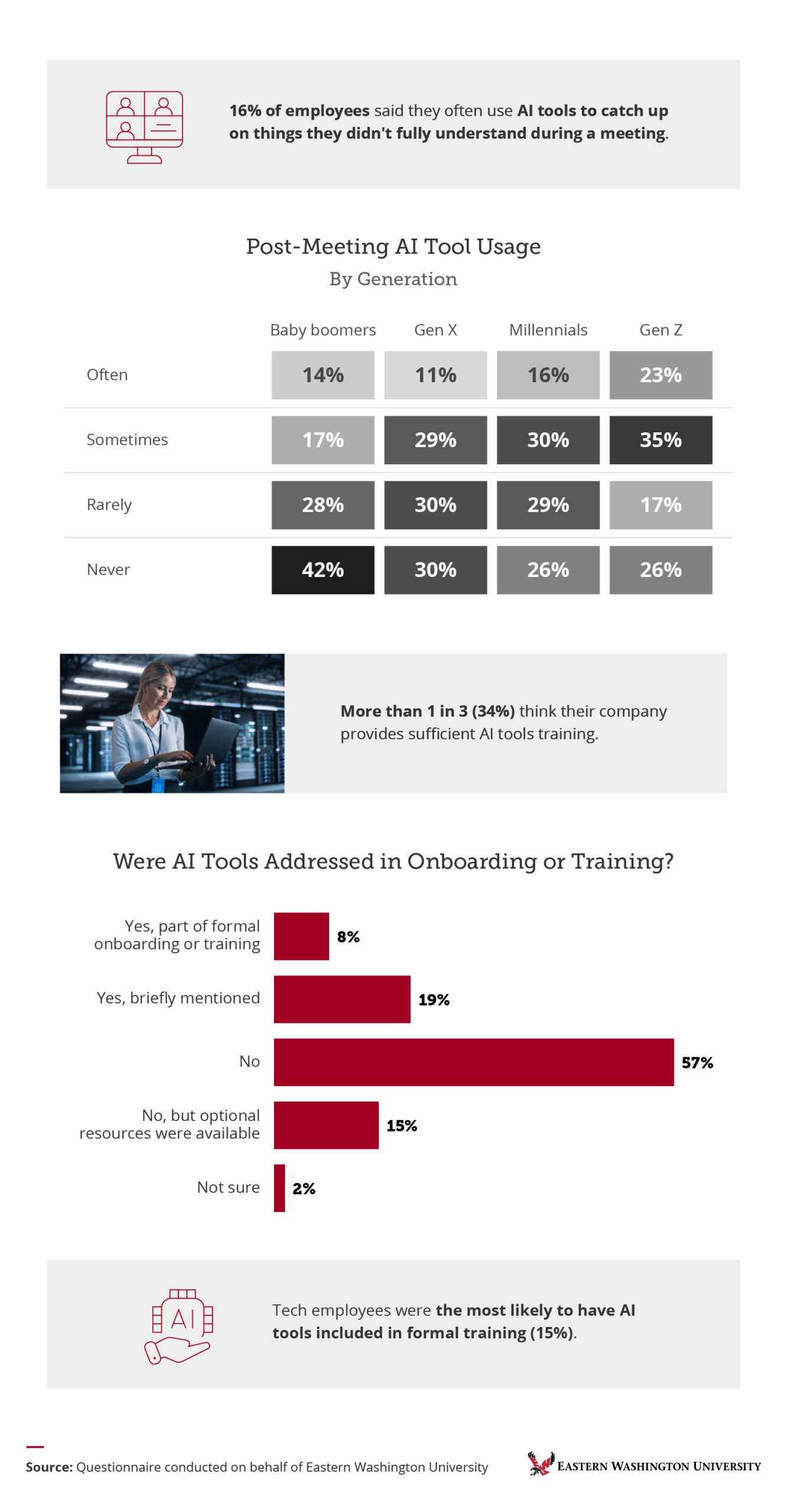
Just 34% of workers believed their company provided sufficient AI training. More than half of employees (57%) said AI tools were not included at all in their onboarding or training, and only 8% reported receiving formal AI training. Workers in tech positions (15%) were the most likely to have received AI training.
When employees encountered confusion during meetings, some relied on AI tools rather than seeking clarification in the moment. Sixteen percent of workers said they often used AI to help them understand information they did not fully grasp during meetings. Gen Z was the most likely to report this behavior, at 23%.
Navigating Confidence in an AI-driven Workplace
The findings suggest that AI can both support and strain employee confidence, depending on how it is introduced and used. While many workers reported skill development and increased confidence, others experienced deeper imposter syndrome tied to heavy or unstructured reliance on AI. Addressing training gaps and encouraging thoughtful use may help organizations balance productivity with employee well-being.
Methodology
This report is based on a questionnaire of 1,000 full-time and part-time employees conducted on behalf of Eastern Washington University to explore experiences with AI and imposter syndrome in the workplace. Respondents included 17% Gen Z, 53% millennials, 25% Gen X and 5% baby boomers. Participants worked across industries, including tech (16%), healthcare (14%), education (12%), retail and hospitality (4%), and other fields (19%). As with any self-reported questionnaire, the findings reflect participants’ perceptions at a single point in time and may not represent the experiences of all workers.
About Eastern Washington University
Eastern Washington University prepares professionals to lead in a world shaped by technology and innovation through flexible, fully online programs. EWU’s online MS – Organizational Leadership, Artificial Intelligence Leadership Concentration program equips students with skills to evaluate and apply AI tools, support ethical and inclusive decision-making, and guide teams through digital transformation.
Coursework blends leadership theory with practical applications of artificial intelligence in organizational contexts, helping learners strengthen their strategic thinking, communication and change management abilities. With accelerated six-week courses and multiple start dates each year, EWU’s online offerings are designed to fit the schedules of working professionals seeking to advance their careers.
Fair Use Statement
The information in this article may be used for noncommercial purposes only. If shared or cited, proper attribution with a link back to Eastern Washington University must be provided.