
Public health careers can vary widely based on location. Job demand, the strength of local healthcare systems, pay levels and day-to-day affordability all influence what early- and mid-career professionals can realistically pursue. To identify where opportunities were strongest, researchers collected and analyzed labor-market and healthcare infrastructure data on behalf of Eastern Washington University (EWU), focusing on the 50 most populous U.S. cities.
This research aimed to help future public health professionals make more informed decisions about where to build their careers. The rankings highlight where job openings and healthcare resources were most concentrated, where pay was highest and where salaries offered greater purchasing power. The analysis also included breakouts by Master of Public Health (MPH) specialization, showing how demand and earnings varied by focus area.
Key Takeaways
- Los Angeles, CA, ranks No. 1 for public health careers, balancing strong job opportunities (1,096 openings), the nation’s most robust healthcare infrastructure (323 facilities) and competitive six-figure salaries ($101,218).
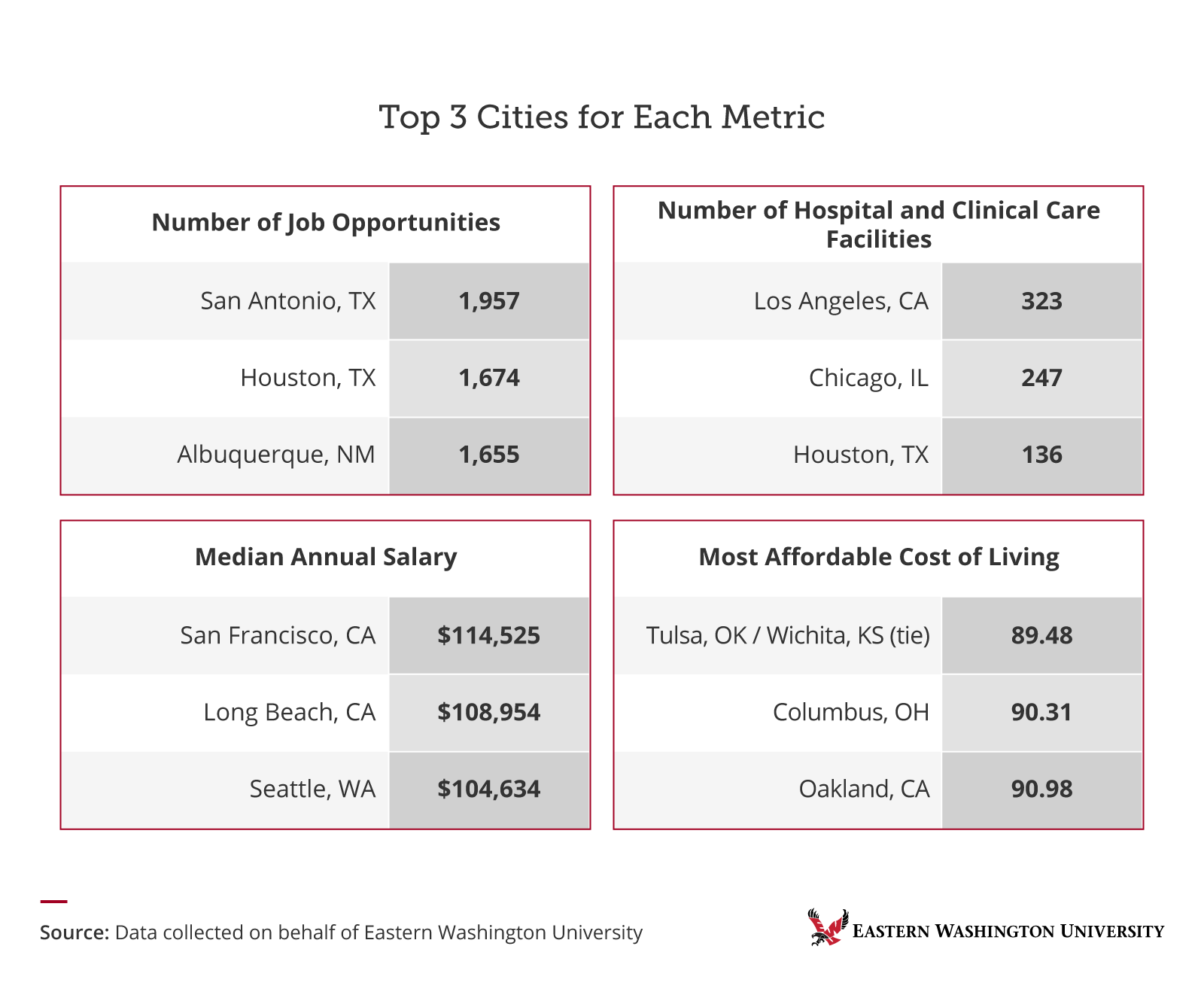
- San Antonio, TX, leads with 1,957 public health job openings, followed by Houston, TX (1,674) and Albuquerque, NM (1,655).
- Los Angeles dominates with 323 hospital and clinical care facilities, far ahead of No. 2 Chicago, IL (247) and No. 3 Houston, TX (136).
- San Francisco, CA, offers the highest pay at $114,525, followed by Long Beach, CA ($108,954) and Seattle, WA ($104,634).
- Tulsa, OK, and Wichita, KS, tie for the best purchasing power (89.48 cost-of-living score), followed by Columbus, OH (90.31).
Overall Ranking: Top Cities for Public Health Workers
Choosing where to build a public health career often requires weighing multiple factors at once. Some cities ranked highly because they performed well across job demand, healthcare infrastructure and pay rather than standing out in only one area. That balance is important, as public health professionals rely on both available roles and the systems that support their work.
Los Angeles took the top spot overall, supported by 1,096 job openings, 323 hospital and clinical care facilities, and a median annual salary of $101,218. Chicago and Houston also appeared among the strongest cities for healthcare infrastructure, with 247 facilities in Chicago and 136 facilities in Houston. Cities that ranked highly tended to pair strong hiring activity with a large footprint of hospitals and clinics.
Top 10 U.S. Cities to Build a Career in Public Health in 2026
- Los Angeles, California
- San Antonio, Texas
- Chicago, Illinois
- Houston, Texas
- Las Vegas, Nevada
- Albuquerque, New Mexico
- Austin, Texas
- Indianapolis, Indiana
- Columbus, Ohio
- Jacksonville, Florida
While the overall rankings show which cities performed best across multiple measures, they do not capture where individual strengths were most pronounced. Some metros ranked lower overall but stood out in specific areas such as job volume, pay or affordability. Breaking the data into individual categories offers a closer look at how different cities excelled across the core factors shaping public health career opportunities.
1. Most Job Opportunities
Cities with the highest number of public health job postings:
- San Antonio, Texas: 1,957 job opportunities
- Houston, Texas: 1,674 job opportunities
- Albuquerque, New Mexico: 1,655 job opportunities
2. Most Hospital and Clinical Care Facilities
Cities with the most robust healthcare infrastructure:
- Los Angeles, California: 323 facilities
- Chicago, Illinois: 247 facilities
- Houston, Texas: 136 facilities
3. Highest Median Annual Salary
Cities offering the highest pay for public health professionals:
- San Francisco, California: $114,525
- Long Beach, California: $108,954
- Seattle, Washington: $104,634
4. Most Affordable Cost of Living
Lower Regional Price Parity (RPP) scores indicate more affordable living costs and greater purchasing power. Cities where public health salaries go the furthest:
- Tulsa, Oklahoma/Wichita, Kansas (tie): 89.48 RPP
- Columbus, Ohio: 90.31 RPP
- Oakland, California: 90.98 RPP
Specialization Shapes Job and Earning Opportunities
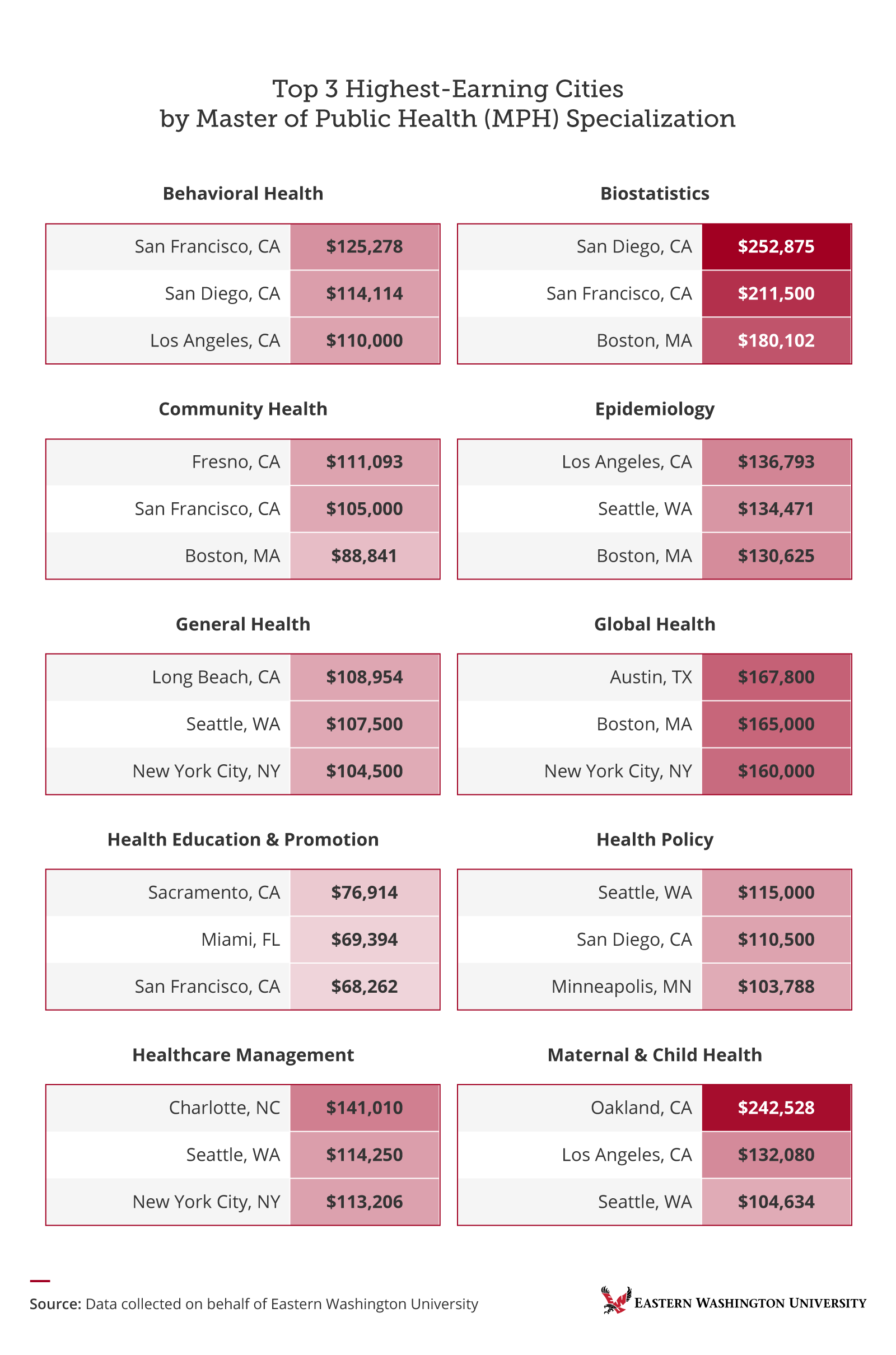
An MPH specialization influenced both where job opportunities were concentrated and how earnings varied across cities. Some markets posted more roles in specific focus areas, while others offered higher pay when salary information was available. Looking at specialization-level data helps connect academic focus areas to real-world hiring demand and compensation patterns.
Top U.S. Cities with the Most Job Opportunities by MPH Specialization
Behavioral Health
- Chicago, Illinois: 93 opportunities
- Houston, Texas: 92 opportunities
- San Antonio, Texas: 82 opportunities
Biostatistics
- Boston, Massachusetts: 33 opportunities
- San Francisco, California: 24 opportunities
- New York City, New York: 21 opportunities
Community Health
- Tucson, Arizona: 114 opportunities
- Albuquerque, New Mexico: 97 opportunities
- Houston, Texas: 91 opportunities
Epidemiology
- New York City, New York: 104 opportunities
- Aurora, Colorado: 90 opportunities
- Atlanta, Georgia: 31 opportunities
General Health
- San Antonio, Texas: 720 opportunities
- Jacksonville, Florida: 630 opportunities
- Houston, Texas: 613 opportunities
Global Health
- Austin, Texas: 108 opportunities
- Phoenix, Arizona: 102 opportunities
- Tucson, Arizona: 100 opportunities
Health Education & Promotion
- Houston, Texas: 52 opportunities
- Dallas, Texas: 37 opportunities
- Chicago, Illinois: 35 opportunities
Health Policy
- Albuquerque, New Mexico: 97 opportunities
- San Antonio, Texas: 93 opportunities
- Phoenix, Arizona: 74 opportunities
Healthcare Management
- Albuquerque, New Mexico: 56 opportunities
- San Antonio, Texas: 52 opportunities
- Austin, Texas: 51 opportunities
Maternal & Child Health
- Austin, Texas: 86 opportunities
- Los Angeles, California: 29 opportunities
- San Antonio, Texas: 26 opportunities
Finding Your Place in Public Health
Location plays a critical role in shaping public health career outcomes. For professionals considering or currently enrolled in an online MPH program, these findings offer some guidance on where to live, work or relocate after graduation. The data bridges the gap between academic preparation and labor-market realities, helping you make informed decisions based on current demand and regional conditions.
Whether you prioritize job volume in your specialization, cost of living or salary potential, understanding how these factors vary by city gives you a clearer picture of your post-graduation options. Your career path is shaped not only by your credentials and expertise but also by the geographic context in which you practice. By considering specialization-specific demand alongside infrastructure and affordability, you can align your career planning with the opportunities that best match your professional and personal goals.
Methodology
This ranking evaluated how well the 50 most populous U.S. cities are positioned for public health careers based on job demand, healthcare infrastructure, affordability and pay. Each city was scored across four metrics. Those scores were scaled, weighted and combined into a single composite score to produce the final rankings.
1) Job Opportunity & Demand (40%)
To measure job availability for public health professionals, active Indeed job postings were pulled and analyzed using a standardized list of public health-related search terms aligned with MPH pathways (e.g., epidemiology, biostatistics, health policy, global health and related public health roles).
Source: Indeed Job Postings
2) Healthcare & Public Health Infrastructure (25%)
To measure how robust each city’s healthcare ecosystem is, a proxy for the environments where public health roles are most likely to exist, two types of facilities were counted:
- Hospitals: Medicare-registered hospitals, including general acute care, psychiatric, rehabilitation, long-term care and children’s hospitals
- Health centers: Federally Qualified Health Center (FQHC) service delivery sites, which provide primary care to underserved populations and are a core setting for community-based public health work
Facility counts reflect city boundaries and were sourced from official federal databases.
Sources:
- CMS Hospital General Information (November 2025)
- HRSA Health Center Service Delivery and Look-Alike Sites (January 2026)
3) Cost of Living/Purchasing Power (15%)
To measure affordability, the Bureau of Economic Analysis (BEA) Regional Price Parities was used to estimate how far earnings go in each metro. Higher scores indicate a lower cost of living (more purchasing power), while lower scores indicate a higher cost of living (less purchasing power).
Source: BEA Regional Price Parities
4) Salary (20%)
To measure earning potential, the median advertised annual salary was calculated among deduplicated Indeed postings that disclosed pay.
Source: Indeed Job Postings
MPH Specialization Breakouts
In addition to the overall ranking, we produced city-level breakouts by MPH specialization using the searchedKeyword field from the Indeed scrape. Keywords were grouped into specialization buckets (e.g., epidemiology, biostatistics, health policy, global health, environmental health, informatics, etc.) to identify:
- The cities with the most job opportunities per specialization
- The cities with the highest median advertised salary per specialization (where sufficient salary disclosures existed)
These breakouts are presented as supplemental insights and do not replace the overall composite ranking.
Scoring & Weighting
Each metric was min-max scaled so the highest-performing city received the maximum score and the lowest-performing city received the minimum score, with all other cities scored proportionally between them. Metrics were then weighted and combined into a final composite score per city:
- Job Opportunity & Demand: 40%
- Healthcare & Public Health Infrastructure: 25%
- Cost of Living/Purchasing Power: 15%
- Salary: 20%
Final scores represent the sum of all weighted metrics. Cities were ranked from highest to lowest composite score to determine the final standings from 1 to 50.
Data Limitations
- Hospital and health center counts reflect city boundaries, not metropolitan statistical areas. Public health professionals may work across municipal boundaries within a metro region.
- FQHC sites specifically serve underserved populations; cities with higher counts may reflect a greater need for community health services rather than the overall size of the healthcare market.
- Job posting data represents a snapshot of advertised positions and may not capture all public health employment opportunities (e.g., government roles posted on separate portals).
About Eastern Washington University
Eastern Washington University offers fully online programs designed for working adults seeking flexible paths to career advancement. Through EWU, students gain foundational knowledge and practical skills in areas such as public health theory, data analysis and community health practice. The online MPH – General program prepares learners to examine health inequities, apply evidence-based approaches and pursue a broad array of public health career roles, such as educator or community health adviser.
Fair Use Statement
This information may be used for noncommercial purposes only. If you share or reference these findings, please include proper attribution with a link back to Eastern Washington University.