Adult learners are rethinking how they build stable careers as job demands shift and new technologies change what employers value. Many working adults now weigh whether an online degree or certificate could help them advance, switch fields or protect their long-term earning power. A questionnaire of 1,000 U.S. adults ages 25 and older was conducted on behalf of Eastern Washington University (EWU) to better understand what is driving adults back to school and what is keeping others on the sidelines.
This study also includes an examination of Google Trends search data to identify where interest in adult education is rising fastest across the country. Together, the research points to a mix of practical motivations, financial concerns and regional differences that shape how adults are approaching continued education.
Key Takeaways
- Nearly one in five Americans over age 25 (18%) plan to go back to school within a year, and another 34% are considering it longer-term.
- Higher pay (64%), personal fulfillment (51%) and career change (31%) are the top reasons why adults are returning to school.
- More than one in five adults (21%) are returning to school for job security due to AI.
- 70% of adults said employer support, through tuition assistance or flexible scheduling, would make them more likely to pursue additional education.
- New York, Georgia and Illinois lead the nation in per capita interest in adult education.
Adult Learners’ Timelines and Top Motivators
Many adults approach education as a career strategy, especially when they can connect learning to a specific outcome at work. Their decisions also reflect what feels feasible alongside existing responsibilities. When employers participate, adults may see education as more attainable and less disruptive.
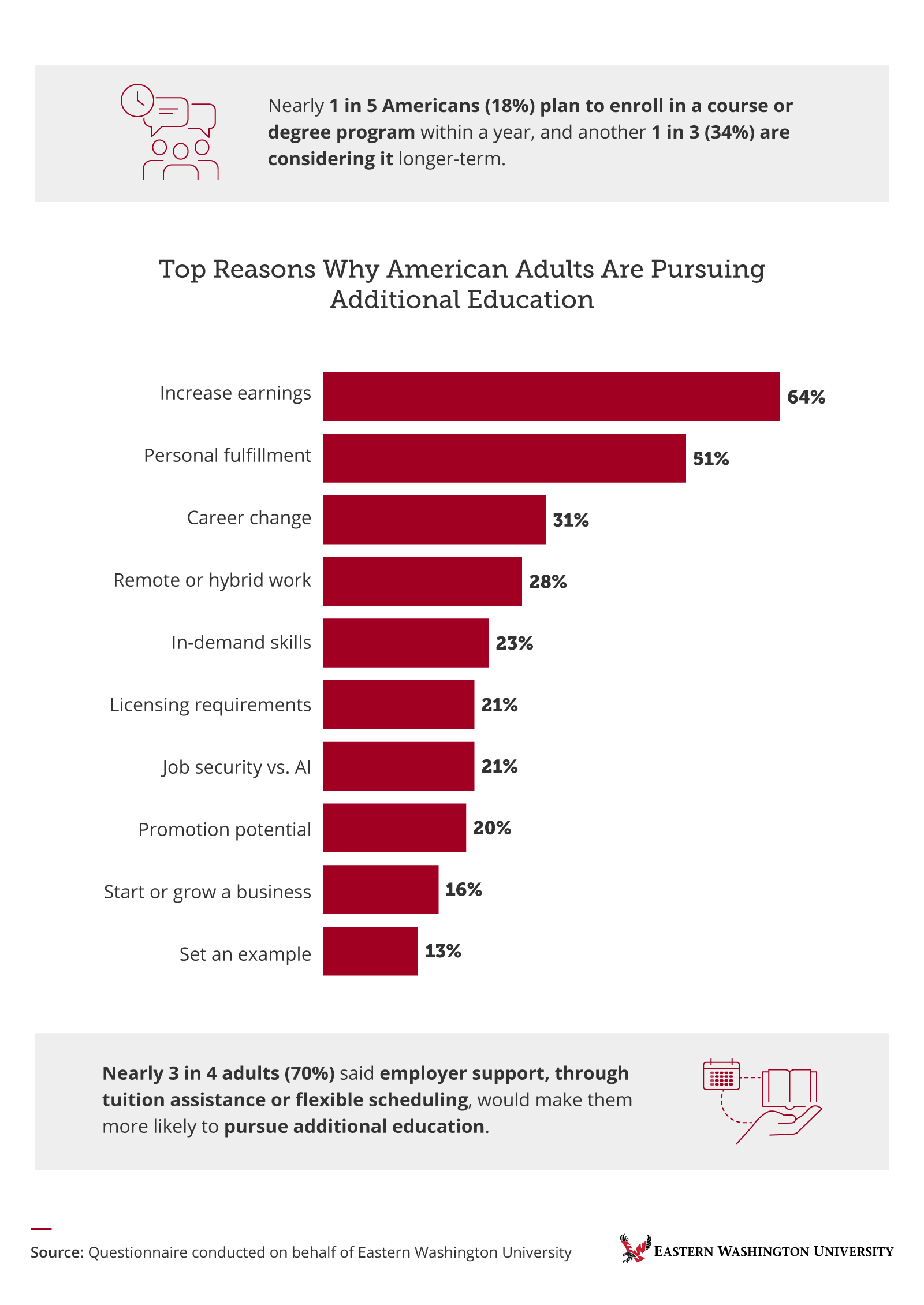
- Nearly one in five Americans (18%) plan to enroll within a year. Another 34% are considering it but won’t enroll within the next year.
- More than one in 10 prospective students (11%) will begin an education program within three to six months.
- Healthcare, tech and hospitality workers are the most likely to enroll in the next 12 months.
- Higher pay (64%), personal fulfillment (51%) and career change (31%) are the top reasons why adults are returning to school.
- More than one in five (21%) adults are returning to school for job security due to AI.
- Nearly three in four adults (70%) said employer support, through tuition assistance or flexible scheduling, would make them more likely to pursue additional education.
Cost Concerns and Career Pressures
Adults often balance the potential benefits of continued education against immediate financial realities. Many also wonder whether new credentials would pay off soon enough to justify the time and expense. At the same time, broader economic pressure and technology-driven change influence how adults view job security.
Top barriers preventing adults from returning to school:
- Tuition and fees: 70%
- Taking on new debt: 56%
- Time constraints from work: 37%
- Family or caregiving responsibilities: 35%
- Doubts about return on investment: 31%
How adults expect to pay for additional education:
- Current income or paycheck: 42%
- Personal savings: 38%
- Scholarships or grants: 33%
- Federal student loans: 32%
- Private loans or credit cards: 23%
Expected time to break even on additional education (tuition, fees and time):
- Within six months: 5%
- 6-12 months: 8%
- 1-2 years: 23%
- 3-4 years: 25%
- 5-9 years: 12%
- 10+ years: 5%
- Do not expect it to pay off financially: 6%
- Not sure: 15%
- Nearly two in five adults worry that their current skills could become obsolete within five years if they don’t continue learning.
- More than one in three adults (35%) said higher living costs are motivating them to go back to school or continue their education.
- Nearly three-quarters of adults (70%) believe additional education would significantly improve their long-term job security.
- Nearly one in three adults (31%) said that AI and automation have increased their interest in returning to school.
Where Interest in Adult Education is Highest in the U.S.
Search behavior can highlight where adults actively explore options for returning to school. Viewing interest on a per capita basis helps compare states more evenly.
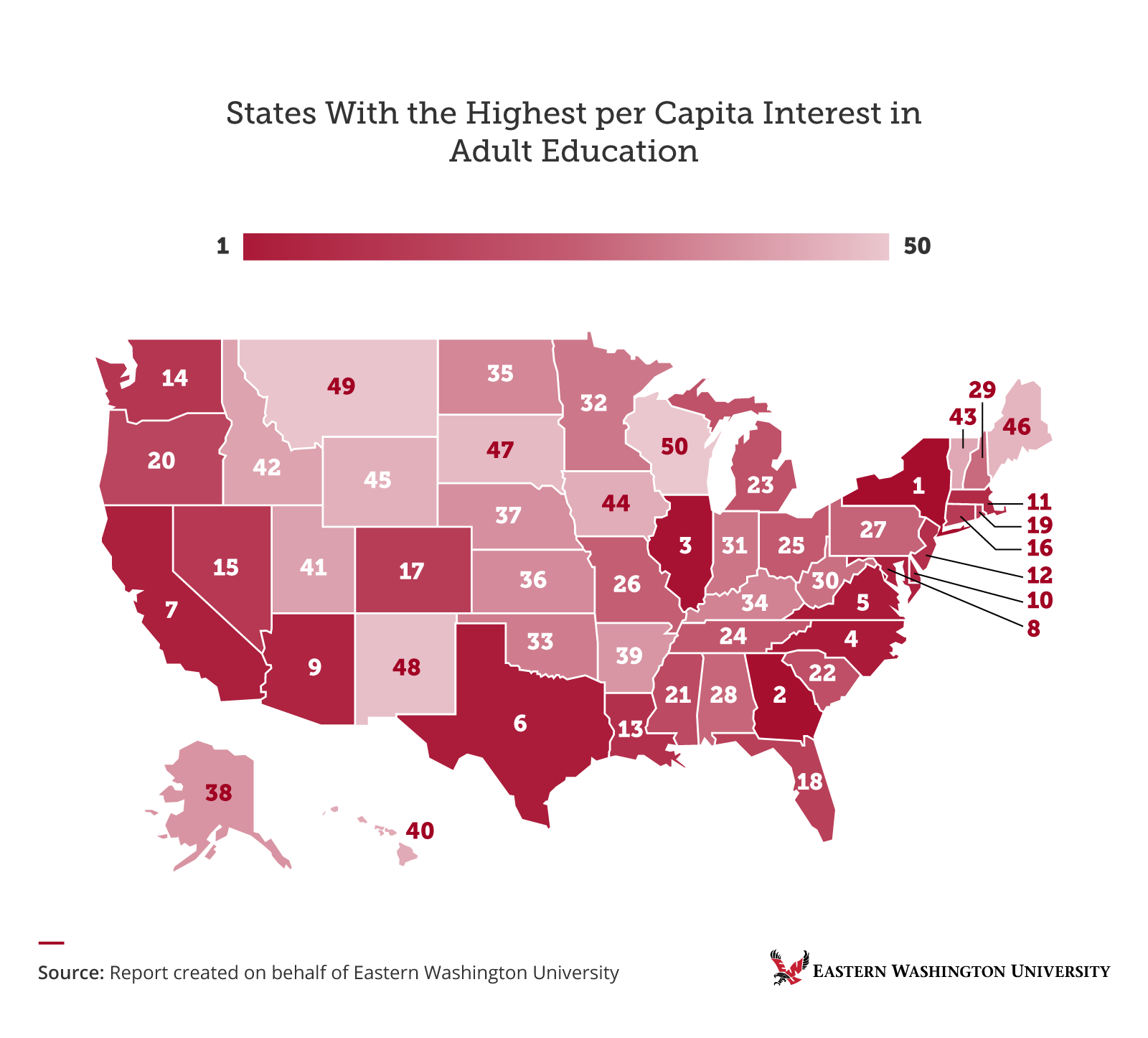
States with the Highest Per Capita Interest in Adult Education
- New York
- Georgia
- Illinois
- North Carolina
- Virginia
- Texas
- California
- Maryland
- Arizona
- Delaware
States with the Lowest Per Capita Interest in Adult Education
- Utah
- Idaho
- Vermont
- Iowa
- Wyoming
- Maine
- South Dakota
- New Mexico
- Montana
- Wisconsin
- The Northeast shows some of the strongest interest in adult education, led by New York (No. 1) and supported by high-ranking states like Maryland (No. 8), Delaware (No. 10), Massachusetts (No. 11) and New Jersey (No. 12).
- The Southeast emerges as a major hotspot for adults returning to school. Georgia (No. 2), North Carolina (No. 4) and Virginia (No. 5) all land in the top five.
- Coastal states, especially in the Northeast, Southeast and Pacific regions, show the highest appetite for adult education, while Western states show some of the lowest per capita interest.
- Rural and Mountain West states show the lowest interest overall.
Methodology
A questionnaire of 1,000 U.S. adults ages 25 and older was conducted on behalf of Eastern Washington University to explore how Americans feel about pursuing additional education, including what motivates them to return to school, what holds them back and how economic pressures shape their decisions. The average age of respondents was 47; 64% were female, 35% were male and 1% were nonbinary. Generationally, 26% were baby boomers and Gen X combined, 62% were millennials, and 12% were Gen Z. Percentages in this study may not total exactly 100% due to rounding.
Google Trends search volume data from December 2024 to December 2025 was also analyzed to identify which U.S. states have the strongest appetite for returning to school. This analysis examined search interest for adult-education and upskilling terms (e.g., “online degree,” “college for adults” and “career change programs”). Search interest was normalized per capita to allow accurate comparisons across all 50 states, accounting for differences in population size. This approach reveals where interest in adult education is growing fastest and where programs may have the strongest opportunity to reach motivated learners.
About Eastern Washington University
Eastern Washington University offers online learning options designed for adults who want to advance their education while balancing work and personal responsibilities. Through EWU’s online graduate degree programs, students can build career-relevant skills in a flexible format that supports long-term professional growth.
Fair Use Statement
This information may be used for noncommercial purposes only. If you share or reference it, please include proper attribution and a link back to Eastern Washington University as the original source.